
Debt All The Way Down

"We are all at a wonderful ball where the champagne sparkles in every glass and soft laughter falls upon the summer air. We know, by the rules, that at some moment the Black Horsemen will come shattering through the great terrace doors, wreaking vengeance and scattering the survivors. Those who leave early are saved, but the ball is so splendid no-one wants to leave while there is still time, so that everyone keeps asking, "What time is it? What time is it?" But none of the clocks have any hands."
– An excerpt from Supermoney by Adam Smith
The Black Horsemen only shows up when you find yourself at a splendid ball—one you can't bring yourself to leave. Consider the following:
The Crash of 1929
The crash that precipitated the Great Depression, followed the Roaring Twenties.
The world-changing technologies of automobiles and radios were being adopted by the masses plus the inception of investment trusts (the precursor to the modern-day mutual fund) which were unregulated, incredibly speculative, and largely funded by debt.
The Flash Crash of 1987
The Dow dropped 22% in a single day and was preceded by an astonishing bull market where the Dow grew by 250% in the five years leading up to the day we now refer to as Black Monday.
The world was entering its digital age as the inception of digital, algorithmic trading and the promise of the burgeoning personal computer made markets hum. Additionally, interest rates began falling for the first time in a decade as the 10yr treasury topped out at nearly 16% in 1981 and had fallen to 7% by 1986. This made borrowing cheaper and led to the proliferation of high-yielding junk bonds, issued to finance hostile takeovers by corporate raiders.
The Dot-Com Bubble
The Nasdaq fell by 78% from its peak and was preceded by a frenzied bull market where the index grew by nearly 600% in the five years leading up to the day it topped out on March 10, 2000.
The internet promised to change the world, which caused investors to begin ignoring corporate profitability. Simultaneously, Wall Street began engineering hyper-aggressive IPOs while tech firms piled on debt to feed their growth.
The Global Financial Crisis of 2008
The S&P 500 plummeted by 57% over a 17-month bear market, following a massive bull run where the index grew by roughly 90% in the five years leading up to its October 2007 peak.
Investors and homeowners were lulled into the belief that real estate values would only go up. This false belief, paired with the use of Collateralized Debt Obligations, added leverage on leverage.
The Takeaway
In every case (perhaps aside from the GFC), each of these bubbles was made possible by a transformative technology, all of which absolutely delivered on their promises to change the world (cars, radio, personal computer, and the internet). However, along with those innovations came a flood of new investment, often in the form of debt, which led to speculation and overshot the actual value created by these technologies.
With that backdrop, it is prudent for us to examine what is going on in the world today as AI promises to upend life as we know it.
Government debt
When governments who are sovereign over their currency incur debt, they can print new money to pay that debt back. When they print money, it trickles through the economy (multiplying on its way down) and pushes up the prices for rent, ground beef, cars, and every other asset—including financial assets like stocks. The problem is so severe, we must ask ourselves whether the growth we have had over the last two decades has been the result of companies growing more efficient and thereby becoming more profitable, or is our "growth" simply the result of new money being forced into markets? Of course, it is some degree of both, but I think it is much more the result of money creation than we realize or would be comfortable to admit.
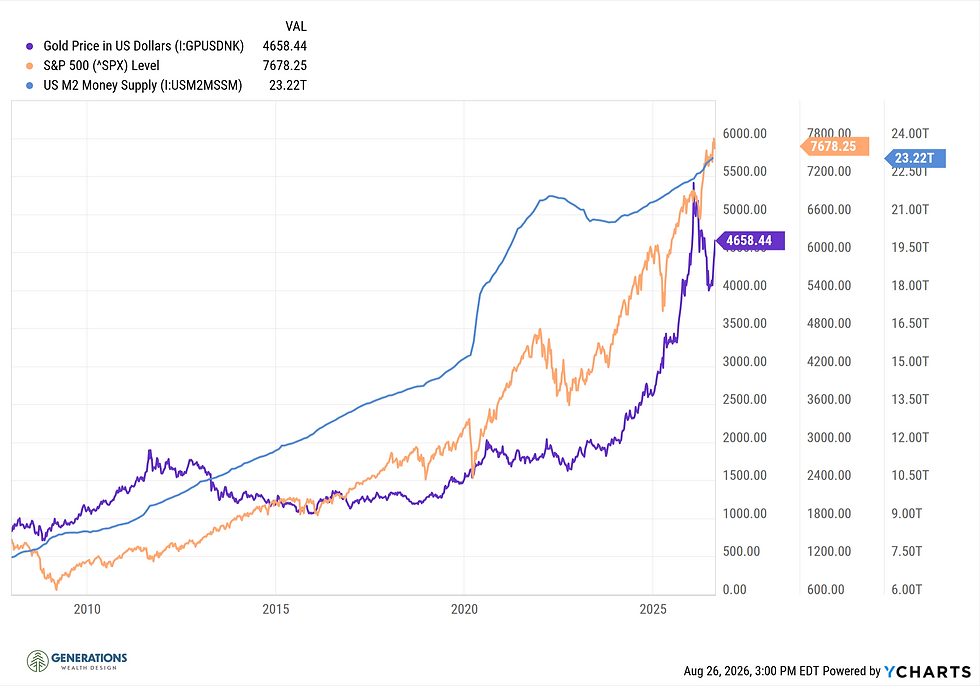
Take the chart below, which shows the price of gold, value of the S&P 500, and M2 (a measure of the money supply in the U.S.) since 1/1/2008 (chosen to account for the last full recession we have experienced). These three measures have grown together at strikingly similar rates:
Past performance is not indicative of future results.
The logical conclusion is that the increase in the money supply has pushed up the price of gold (which has a fixed supply and is thus a great scale to examine the extent of money printing and the consequent inflation) and the S&P 500. This is not what investors should desire to see—the hope is that cash flowing businesses gain in productivity and are able to grow their margins, thus outpacing the rate of growth of an asset whose primary purpose is to be a store of value, such as gold. However, that does not appear to have been the case for the past 18 years. Instead, we are smitten by the growth in our portfolios, which is actually just the deterioration of our money.
Of course, the money supply increasing is a symptom of our national debt increasing. After all, every time the U.S. issues debt, it is effectively creating "money" that did not previously exist. Recently, the level of U.S. debt surpassed $40 trillion (that was trillion… with a T), according to Treasury Department figures. To put that in perspective:
Traveling back one million seconds was about 12 days ago.
Traveling back one billion seconds was about 32 years ago.
Traveling back one trillion seconds was about 31,688 years ago.
Traveling back 40 trillion seconds would be 1,267,520 years ago.
Just like if you or I had outstanding credit card debt and allowed the interest to compound on itself, so too does the debt of the United States government. In fact, the U.S. government spends over $1T on interest payments alone, which is the second largest line item on its budget after entitlements (Social Security/Medicare). And of course, we are not the only government in the world that is printing money.
The problem has gotten so out of hand and future inflation expectations are so high, that investors have a reduced appetite for owning long-dated U.S. debt (10 – 30yr treasury bonds) that yields have begun steadily increasing, meaning, the U.S. government's interest rate on its credit card is increasing. To combat this, the Treasury Department is actively buying back long-dated treasury bonds to create synthetic demand for the bonds and drive the yields back down—an unusual intervention that we think will ultimately worsen the havoc wreaked by the black horseman rather than prevent it.
The AI arms race (funded by corporate debt)
As you might have heard, there is currently an arms race among the heavyweight companies of the world to become the first to reach agentic AI—a level of artificial intelligence essentially able to reason on its own. These companies can't afford to sit the race out, and they can't afford to finish second, so they are throwing everything they've got to win the race. The companies known as "hyperscalers"—Microsoft, Alphabet (Google), Meta (Facebook/Instagram), Amazon, and Oracle—have gone from having so much excess cash flow they opted to repurchase hundreds of billions of their own shares in recent years, to fully reversing course and issuing hundreds of billions of dollars of debt on their balance sheets, plus an estimated $1.6 trillion–$3 trillion in debt and other obligations off their balance sheets, to finance their AI-related investments. This is concerning in and of itself, but is especially concerning when paired with the government debt covered above. These companies (with the likely exception of Oracle) are seen as good, if not better, credit risks than the United States government, but they are still offering higher yields on their bonds than are currently being paid by U.S. treasury bonds. So, if you're an investor in the market for a long-dated bond, why would you buy a treasury bond when you can lend to a better borrower at a higher rate? The result is that treasury yields have increased to remain somewhat competitive with the recent and massive debt issuance from these companies, further throwing gas on the fire the government is actively trying to fight.
Private credit (debt not publicly traded)
Private credit is the term for private funds that make private loans (not tradeable on secondary markets) to mostly private companies (not listed on a public exchange). These funds have been all the rage over the last decade, as the underlying loans are not priced every day like publicly traded loans, so the value of the fund rarely moves. This gives the illusion of stability. Furthermore, the loans issued by the fund are often higher-yielding than publicly traded debt, which is very appealing in our low-rate world. However, retail and annuity/life insurance companies (which have made a habit of investing in private credit and private equity funds) can end up taking on massive, hidden risk if they don't have a clear view of what they—or the companies issuing their policies—are ultimately invested in.
A developing story, as reported in the financial press, involves allegations that Mark Walter and Guggenheim Partners funneled up to $20 billion in retiree savings from insurance companies under Walter's control into their own ventures, including companies affiliated with Walter's stake in the Los Angeles Dodgers—reportedly structuring risky ownership stakes as loans in a way that would sidestep cash-reserve rules governing insurance company investments. The reporting also describes a similar structure allegedly used when Guggenheim deployed life insurance funds to issue a $300 million private credit loan to LeBron James against his future endorsement income. These are allegations, not adjudicated findings, but they illustrate the kind of opacity we're pointing to.
I plan to write more on this topic at a later date, but for today, it is important to know that there is another $3 trillion+ market for debt that is private (opaque) in nature, and dependent upon the punch bowl not running out.
Any one of these three risks, fully played out, could be a black swan event. The fact that all three have built to their current level is concerning to say the least. Furthermore, any of these three blowing up would almost certainly ignite the other two.
What can you do about it?
The analogy of the Black Horseman breaking into the ball and wreaking havoc breaks down in one big way—it insinuates a binary choice—leave the party and regret leaving too early or stay at the party and suffer destruction. In the real world, investors have a lot of grey in between those black and white options.
Our job as investment managers is to put clients in a position where they feel great about their wins and can stomach their losses, which is extremely difficult. Of course, navigating markets presents plenty of challenges, but I would argue the most complicating (and most gratifying) task we have is continuously helping clients develop a better understanding of their portfolio so they can make increasingly informed decisions. Hard times are a certainty—they will happen. Outside of spending and saving habits, I would argue that investors' behavior during those tumultuous periods carries more importance in the context of their long-run financial health than any other variable (the two most important variables are under your control). However, that doesn't give license to not prudently think through the risk in your portfolio before it's too late. Here is how we are generally thinking about the landscape and portfolio construction philosophy going forward—not as a recommendation for any individual portfolio, but as the framework shaping our thinking:
We believe staying invested in equities remains important. The black horseman is likely to give the party a visit at some point, but we have no clue when. The government appears likely to keep the printer running at an increasing rate, so an allocation that entirely avoids assets that could benefit from resulting inflation risks is certain to lose its purchasing power over time. This doesn't mean every investor should hold the same equity exposure—someone later in retirement who doesn't need decades of inflation-beating growth may reasonably carry less.
Hard, finite assets are the kind of thing we'd expect to hold up in a hyper-inflationary environment—gold, soft commodities like ag products, hard commodities like base metals, infrastructure, and real estate. That said, these asset classes can be capable of violent volatility, so exposure to them warrants care and isn't a fit for every investor or every portfolio.
We're generally cautious on long-duration bonds. While they might benefit in the short run from the artificial demand created by Treasury buybacks, we'd expect them to struggle in a rising-rate environment, which is part of why we tend to favor shorter-duration bonds within the fixed income sleeve of a portfolio.
Reducing risk without overextending into fixed income is a real challenge. Fixed income is exactly what it sounds like—and if inflation (and thus, interest rates) is growing exponentially, you don’t want your returns to be fixed. Buffered products and hedged equity strategies are two vehicles we think are worth understanding for that purpose, depending on individual circumstances.
If an investment seems too good to be true, it's because it is. If you come across a fund or investment vehicle offering an exorbitant yield like we have seen in private credit for a decade, there is risk under the surface. Private credit funds have been the sirens' song for years now, and unfortunately, it looks like some ships they lured in are now crashing on the rocks.
Conclusion
We don't know which of these threads unravels first, or whether any of them do — and pretending we could time it would be asinine. What we can control is how the portfolio is built: staying invested but deliberately positioned so that when volatility does show up, it finds you prepared rather than exposed.
This commentary reflects our general views on markets and the economy as of the date written. It is provided for informational and educational purposes only and does not constitute personalized investment, legal, or tax advice. It should not be construed as a recommendation to buy, sell, or hold any particular security or to pursue any particular investment strategy. Individual circumstances vary, and you should consult with your advisor before making any changes to your portfolio. Past performance is not indicative of future results.


